

Most people who start a home business do it the same way. They have an idea, they try a few things, and then they wait to see what sticks. They hedge. They stay comfortable. They never fully commit to the version of the business that actually has a chance of winning.
Tabitha Glista did none of that.
I’ve known Tabitha since we were freshmen at Frontier High School in Buffalo in 1999, two music nerds grinding through sight-singing and show choir while everyone else was in gym class walking laps. She went on to study flute performance at Baldwin Wallace, worked at Carnegie Hall, and then, during the pandemic, did something that had nothing to do with any of it: she started baking cookies in her mother’s kitchen.
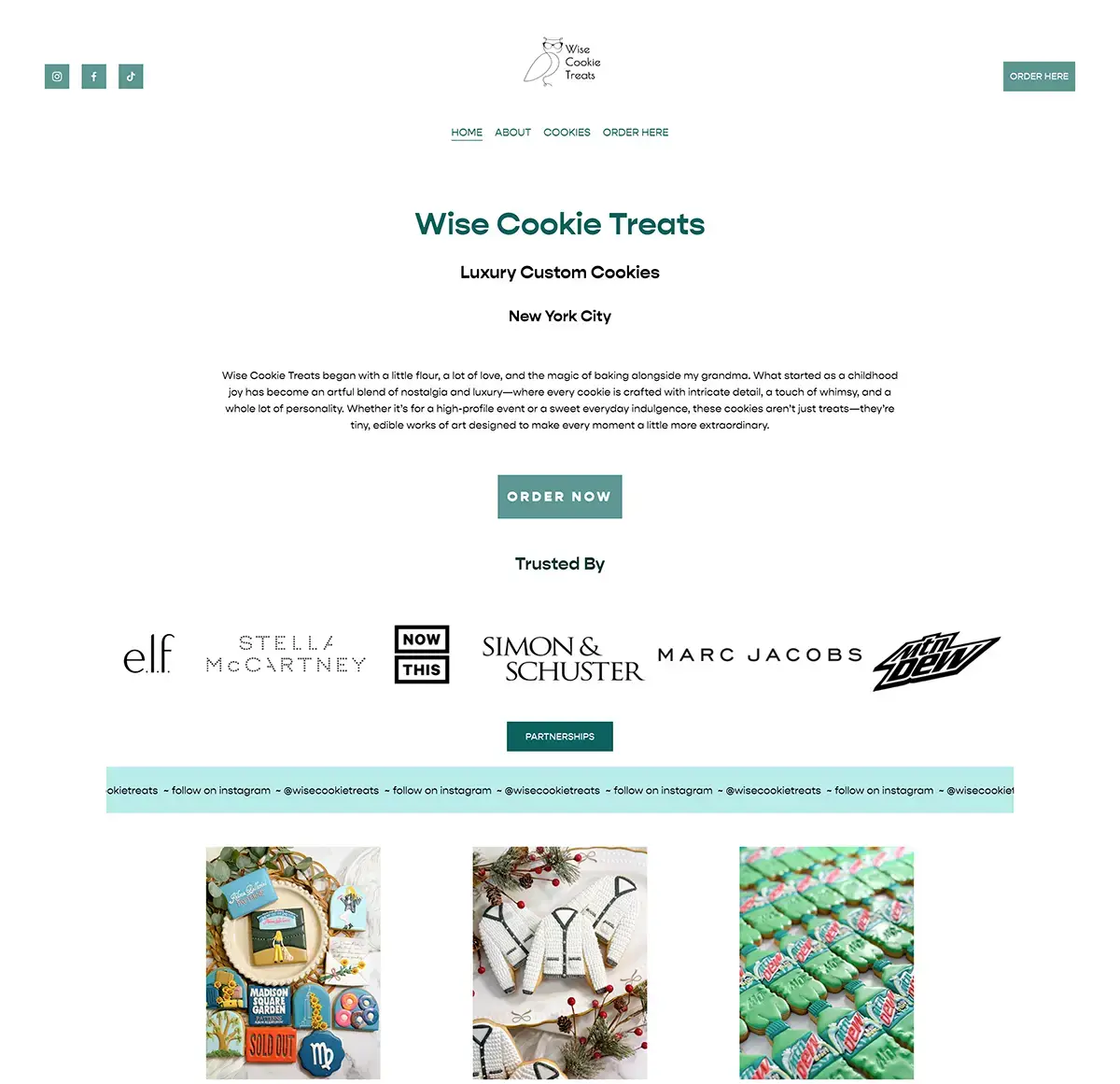
Today, Wise Cookie Treats is one of the most in-demand custom cookie businesses in New York City. She’s baked for Broadway openings, celebrity clients, Fashion Week, and a retail partnership at the Oculus. She built it from zero, with no culinary training, no startup capital, and no industry connections.
Here’s what she did right.
Go Deep Before You Go Wide
When Tabitha decided to get serious about cookies, she didn’t try to serve everyone. She didn’t open an Etsy shop and ship nationwide. She focused on custom, decorated cookies for clients who wanted something genuinely special, and she went deeper into that niche than anyone around her was willing to go.
She taught herself color matching. She bought a projector so her designs would be perfectly consistent. She took online courses specifically about converting digital images into accurate frosting colors. She bought 400 cookie cutters and dedicated an entire bedroom in her New York City apartment to the operation.
That level of commitment to craft is what separates the businesses that get Instagram followers from the ones that get repeat clients and referrals.
I’ve said a version of this before on this podcast and I’ll keep saying it because it keeps being true: the year I decided to become the Battery Park City agent, not a Battery Park City agent but the one, was the year everything changed. A hundred and ten deals in a single year didn’t come from a marketing budget. They came from going deeper than anyone else was willing to go in a single neighborhood until the market had no choice but to recognize me.
The question worth asking about your own business is not where can I fit in. It’s where can I go so deep that I become impossible to ignore.
Your First Customers Are Your Most Important Ones
Tabitha didn’t launch with a polished brand. Her first cookies were, by her own description, hideous. An alarming shade of teal. Technically a mess. But they tasted good, and she sold them to her friends, not because the product was ready, but because the relationship was real.
Those early customers gave her something more valuable than revenue. They gave her honest feedback. They told her what was working and what wasn’t. They posted about her cookies because they wanted to support her, and that word-of-mouth became the foundation of a client base she’s been building ever since.
There’s a principle here that applies to any service business. Your first clients don’t need you to be perfect. They need you to be genuine, to deliver something they find valuable, and to actually listen to what they tell you. The relationship you build in those early days is harder to replicate than the product itself.
I started in New York City real estate with no network, no wealthy friends, and no referral pipeline. What I had was a willingness to show up, stay honest, and take every piece of feedback seriously, including the uncomfortable kind. That foundation is still what the business runs on.
Not Everyone Is Your Customer. That’s a Feature, Not a Bug.
This is the part of the conversation I want to stay on for a minute because it’s something most entrepreneurs figure out late, usually after burning themselves out on the wrong clients first.
Tabitha charges what her work is worth. She uses premium ingredients. One cookie, from planning to packaging, can take up to eight hours. When a potential customer tells her that’s not in their budget, she doesn’t negotiate herself down. She says that’s okay, wishes them well, and moves on.
She said something that I’ve heard very few early-stage entrepreneurs say with actual confidence: custom cookies are a luxury item, and they’re not for everyone.
I know what it takes to get to that place. When I started, I said yes to everything and everyone because I was building from zero and the volume felt necessary. But there’s an inflection point in every business where you realize that the wrong clients cost you more than they’re worth, in time, in energy, in the toll it takes on the work itself. Once Tabitha started saying no to orders that didn’t feel right, three genuinely great clients came in right behind them. That’s not a coincidence. That’s what happens when you stop filling your calendar with the wrong work.
The sooner you figure out who your actual client is and have the confidence to only serve them, the faster everything moves.
The Unglamorous Truth About Running a Serious Business
Here’s what Tabitha’s week actually looks like. Sunday is dough day: about twenty pounds of butter, twenty dozen cookies, one tray at a time through the oven, thirteen to fourteen minutes each. Monday through Friday she decorates up to six dozen per day. Between all of that, she’s answering intake emails in the morning before her husband finishes making breakfast, and again at night before bed. She doesn’t check messages in between.
She has a 48-hour deposit policy. Once you inquire, you have two days to lock in your order or the spot goes to someone else. She doesn’t chase. She doesn’t make exceptions. The system works because she built it and she holds the line on it.
I’ve talked on this podcast before about Jesse Milleson, who owns the number one OrangeTheory studio in the world. Early in his career he made a promise to himself: if one person shows up, coach like there are forty-five. Seven thousand classes later, that standard hasn’t changed.
That’s what a real business looks like on the inside. Not glamour. Not overnight wins. The same process, executed the same way, at the same level, every single time. Boring at scale is what success feels like when you’re in the middle of it.
Find Your Community Before You Need It
The most surprising thing Tabitha told me, and the thing I think most aspiring entrepreneurs are least likely to actually do, is that before she made her first serious cookie, she went and found the cookie community in New York City.
She cold-DM’d bakers on Instagram. She asked them what wasn’t working before she started. She wanted to know where the landmines were so she didn’t step on them. She came in with zero ego and a lot of questions, and the people she reached out to were generous with their answers. Some of those connections are still active today.
I did a version of this when I was building in Battery Park City. The agents I respected most in that neighborhood were technically my competitors. But I called them when I had questions. I watched how they handled things. I tried to learn faster by not pretending I already had it figured out.
The entrepreneurs who skip this step, who come in convinced they have the best idea and everyone else is the competition, are the ones who spend years learning lessons that were freely available if they’d just asked. Your community is a resource. Use it before you need it.
The Business You Build Owns You as Much as You Own It
Tabitha mentioned something near the end of our conversation that I’ve thought about a lot since: cookies found her at the right moment. The pandemic, the furlough, her grandmother’s kitchen at Easter. If she had tried to force it five years earlier, who knows. The timing was part of it.
But timing only matters if you’re paying attention when the moment arrives, and if you’re willing to go all the way in once it does.
She went all the way in. She invested in the equipment. She studied the craft. She built the systems. She found the community. She held the line on pricing and clients. She did the Sunday dough days and the late-night emails and the six-dozen-a-day decorating sessions. And now she has a business that books out weeks in advance, sells at the Oculus, and bakes for Broadway.
None of that happened by accident. It happened because when she found what worked, she stopped hedging and committed.
That’s the whole game, in cookies and in real estate.
If you’re buying, selling, or investing in New York City real estate and want to work with someone who has been going deep in this market for over a decade, let’s talk. And if you’re exploring Pittsburgh real estate listings as part of your next move, our team can help there too.